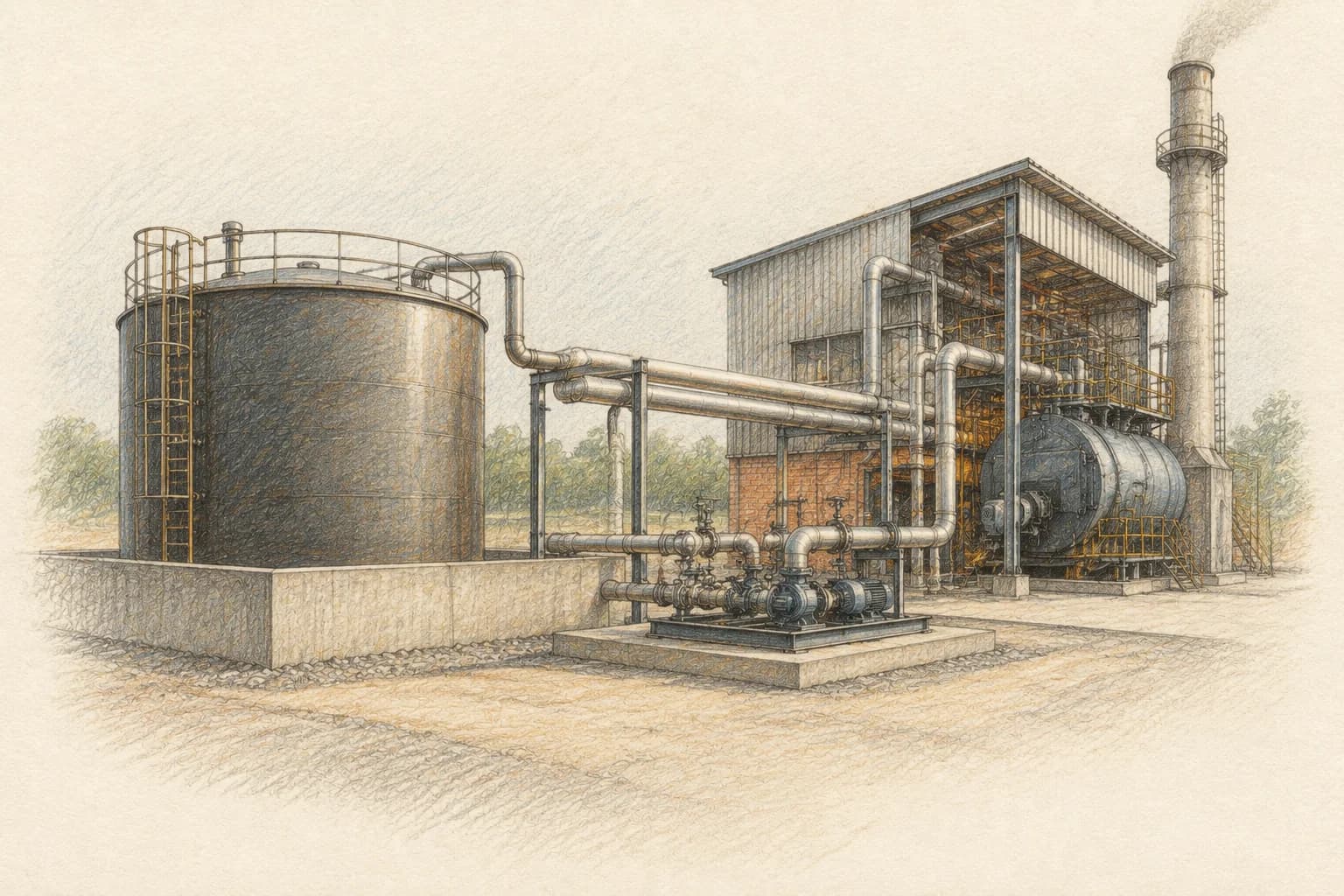
Furnace oil is a heavy residual fuel used in industrial boilers, process furnaces and thermic fluid heaters. It carries a lot of energy per kilogram, but it only releases that energy cleanly when the oil, the burner and the air supply are properly matched. Most combustion problems with furnace oil trace back to a handful of factors.
Viscosity and preheating
Viscosity is the most important property in handling and burning furnace oil. It decides how much the oil must be heated for pumping, storage and atomisation. Furnace oil is not easily pumpable at ambient temperatures below about 25°C, and at the burner it must be thin enough to break into a fine spray. Energy efficiency guidance for industry gives a preheat of around 105°C to reach the viscosity commonly needed at the tip of low-, medium- and high-pressure air atomising burners. The right figure for your plant depends on the oil's viscosity–temperature curve and on the burner maker's requirement.
Oil that reaches the burner too cold sprays in coarse droplets, is harder to light and leaves carbon deposits on burner tips and furnace walls. Heaters need thermostatic control as well: if flow drops or stops while an electric heater stays on, the oil can carbonise.
Atomisation
The burner's job is to turn a stream of oil into fine droplets with a large surface area, so they vaporise and burn quickly. Pressure-jet, air-atomising and steam-atomising burners all depend on the correct oil pressure and temperature to do this. Worn, damaged or dirty nozzles produce an uneven spray and a poorly shaped flame, so tip inspection and cleaning belong in routine maintenance.
Air supply and the three Ts
Complete combustion depends on the three Ts: a temperature high enough to ignite and sustain the fuel, turbulence to mix fuel and air thoroughly, and enough time for burning to finish. Oil needs some air beyond the theoretical amount to burn completely, but every extra kilogram of air is heated and carried up the stack. Industrial guidance suggests limiting excess air for oil firing to about 15%, which corresponds to roughly 2 to 3% oxygen, or 14 to 15% carbon dioxide, in the flue gas. Regular flue gas checks for oxygen, carbon monoxide and stack temperature are the practical way to keep a burner tuned.
Fuel quality factors
The table shows typical furnace oil characteristics from published industrial guidance and what each one does in the boiler.
| Property | Typical value | Effect on combustion and equipment |
|---|---|---|
| Water | 1.0% by volume max | Flame sputter and possible flame-out, lower flame temperature, longer flame; dissolved salts damage furnace surfaces |
| Sulphur | Commonly 2 to 4% by mass | Forms sulphuric acid that condenses in cooler parts of the stack, air preheater and economiser |
| Ash | 0.1% by mass max, often 0.03 to 0.07% | Fouling deposits, burner tip erosion, refractory damage and high-temperature corrosion |
| Carbon residue | 1% or more | Carbon deposits on burner tips and other hot surfaces |
| Sediment | 0.25% by mass max | Blocked strainers and filters, uneven spray |
Sulphur also limits how far the flue gas can be cooled for heat recovery. If the gas is cooled too far, acid condenses on the coldest surfaces, so heat recovery equipment is designed with a minimum exit temperature in mind. Low sulphur heavy stock, with sulphur below 0.5%, reduces this risk but often needs bulk heating of the whole storage tank rather than an outflow heater.
Storage and supply to the burner
- Fit strainers on the tank inlet, between tank and pump, and before the burner to keep debris and sludge away from pumps and nozzles.
- Drain settled water and sludge from storage tanks regularly, and clean heavy fuel tanks periodically.
- Use positive displacement pumps for heavy oil; they move cold, viscous fuel better than centrifugal pumps.
- Do not store oil hotter than needed for pumping, as this only adds to energy use.
A well-tuned burner on poorly heated or wet oil will still burn badly. Fuel condition and burner settings have to be right together.
Buying furnace oil for a boiler
When enquiring for furnace oil, give the standard you buy to, or a specification with limits for viscosity, sulphur, water, ash, sediment, flash point and pour point. Tell the supplier what burner type you run and how much preheat capacity you have. Nuroil provides a certificate of analysis with each delivery and the MSDS on request, so your plant team can confirm the oil suits the burner before it is decanted into storage.