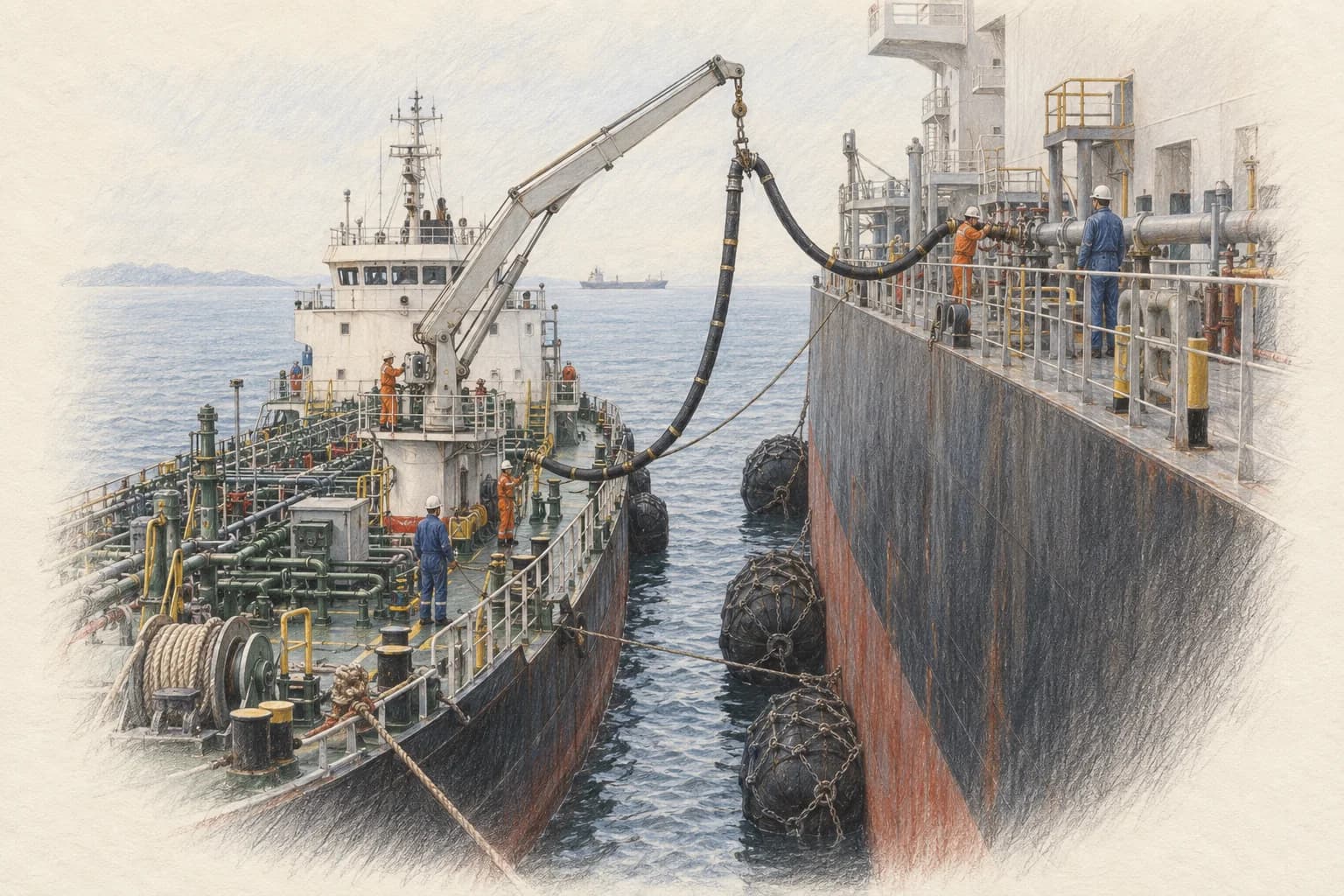
Sulphur occurs naturally in crude oil, and much of it ends up concentrated in the heavy residues used to make marine fuel. When the fuel burns, that sulphur leaves the funnel as sulphur oxides (SOx). The limits on sulphur in ship fuel exist to control those emissions, but they also shape how fuel is blended, stored and burned on board.
What happens to sulphur when fuel burns
In the combustion chamber, sulphur reacts with oxygen to form sulphur dioxide and a smaller share of sulphur trioxide. In the atmosphere, SOx is linked to respiratory, cardiovascular and lung disease, particularly for people living near ports and coasts. It also contributes to acid rain and to acidification of the sea.
Inside the machinery, sulphur trioxide combines with water vapour to form sulphuric acid, which condenses on cooler metal surfaces such as cylinder liners, exhaust gas economisers and the cooler sections of boiler uptakes. This is why cylinder lubricants for two-stroke engines are formulated with alkaline reserve matched to the sulphur level of the fuel being burned.
The current limits
The limits are set in Annex VI of MARPOL, the international convention for the prevention of pollution from ships, under Regulation 14. Since 1 January 2020 the sulphur content of fuel used on board outside designated emission control areas (ECAs) may not exceed 0.50% by mass, down from the previous 3.50%. Inside ECAs the limit is 0.10%.
| Situation | Maximum sulphur in fuel used | Typical fuels |
|---|---|---|
| Outside emission control areas | 0.50% m/m | Very low sulphur fuel oil (VLSFO), marine gas oil |
| Inside emission control areas | 0.10% m/m | Marine gas oil and other 0.10% fuels |
| Ship fitted with an approved exhaust gas cleaning system | Higher-sulphur fuel allowed as an equivalent means of compliance | High sulphur fuel oil (HSFO) |
The long-established ECAs cover the Baltic Sea, the North Sea, the North American coastal area and the United States Caribbean Sea area. The Mediterranean Sea has applied the 0.10% limit since 1 May 2025, and further areas have been adopted with later start dates, so operators check the current list when planning each voyage.
A carriage ban has applied since 1 March 2020. A ship without an approved exhaust gas cleaning system may not carry fuel above 0.50% sulphur for its own propulsion or operation. The ban does not cover fuel carried as cargo.
How ships comply
- Compliant fuel. Most ships burn VLSFO, usually a blend of low-sulphur residual and distillate components, or marine gas oil.
- Exhaust gas cleaning systems. Scrubbers wash SOx out of the exhaust and are accepted by flag administrations as an equivalent method, which allows higher-sulphur fuel to be burned. Washwater from open-loop systems must meet discharge criteria, and residues from closed-loop systems go to port reception facilities.
- Alternative fuels. LNG and some biofuels contain little or no sulphur.
Why low sulphur changes fuel handling
Lowering sulphur is not just a change of one number on a certificate. Blended 0.50% fuels can vary more from one delivery to the next in viscosity, density, pour point and composition. Two fuels that each meet the limit may be incompatible when mixed, forming sludge that blocks filters and overloads separators. The industry responded with ISO/PAS 23263, which sets out quality considerations for 0.50% fuels including stability, compatibility, cold flow properties, ignition characteristics and catalyst fines, together with handling guidance from engine and fuel bodies.
On board, that translates into a few habits: keeping new deliveries segregated from fuel already in the tanks, testing compatibility before any mixing, watching pour point in cold weather, and planning fuel changeovers carefully when entering or leaving an ECA so that the right fuel is in the engine at the boundary.
Sulphur limits are a statutory requirement. Every tonne burned must meet the limit for the sea area the ship is in, and the paperwork has to prove it.
What to specify when buying
For marine fuel, state the maximum sulphur content you need (0.50% or 0.10%, or a high-sulphur grade for a ship with a scrubber) alongside the ISO 8217 grade. Ask for a certificate of analysis that reports sulphur by a recognised test method, and expect the bunker delivery note to record the sulphur content to two decimal places. Nuroil can arrange third-party inspection on request where a buyer wants independent confirmation of sulphur and other key parameters before shipment.