Heavy fuel oil spends its life being warmed up. It must be warm enough to pump out of storage, warmer still to separate and filter, and hot enough at the injector or burner to atomise properly. At the same time it must never be heated so far that it becomes a fire risk or wastes energy. This guide sets out how to think about each stage.
Three reference points
Every heating decision comes back to three properties shown on the certificate of analysis or the supplier's data sheet:
- Pour point is the lowest temperature at which the oil will still flow under test conditions. It is only a rough indication of the lowest temperature at which the oil can be pumped, so storage and lines should be kept comfortably above it.
- Flash point is the lowest temperature at which the oil gives off enough vapour to flash when a flame is applied. Fuel for ships' machinery spaces generally must have a flash point of at least 60°C, and furnace oil is typically around 66°C.
- Viscosity–temperature behaviour shows how quickly the oil thins as it warms. Plotting the certificate viscosity on the supplier's chart lets you read off the temperature needed at each stage.
Temperatures by stage
| Stage | Aim | Practical guidance |
|---|---|---|
| Bulk storage | Keep the oil pumpable | Hold above the minimum pumping temperature, but no higher. One supplier's guidance for a 500 cSt residual fuel was to keep storage at or above 45°C. |
| Transfer | Move oil without overloading pumps | Heat the oil leaving the tank, with an outflow heater or tank heating coils, to the pumping temperature for the grade. |
| Settling and service tanks | Let water and solids settle; feed separators | Follow the engine and separator maker's settings for the grade being burned. |
| Final heater outlet | Reach injection or atomising viscosity | Marine engines typically need about 10 to 15 cSt at the injector. For a heavy residual grade this can mean 140 to 155°C. Furnace oil burners commonly need around 105°C. |
These figures are examples, not settings. Use your own fuel's certificate, the viscosity chart and the equipment maker's instructions to set each temperature.
Heating methods
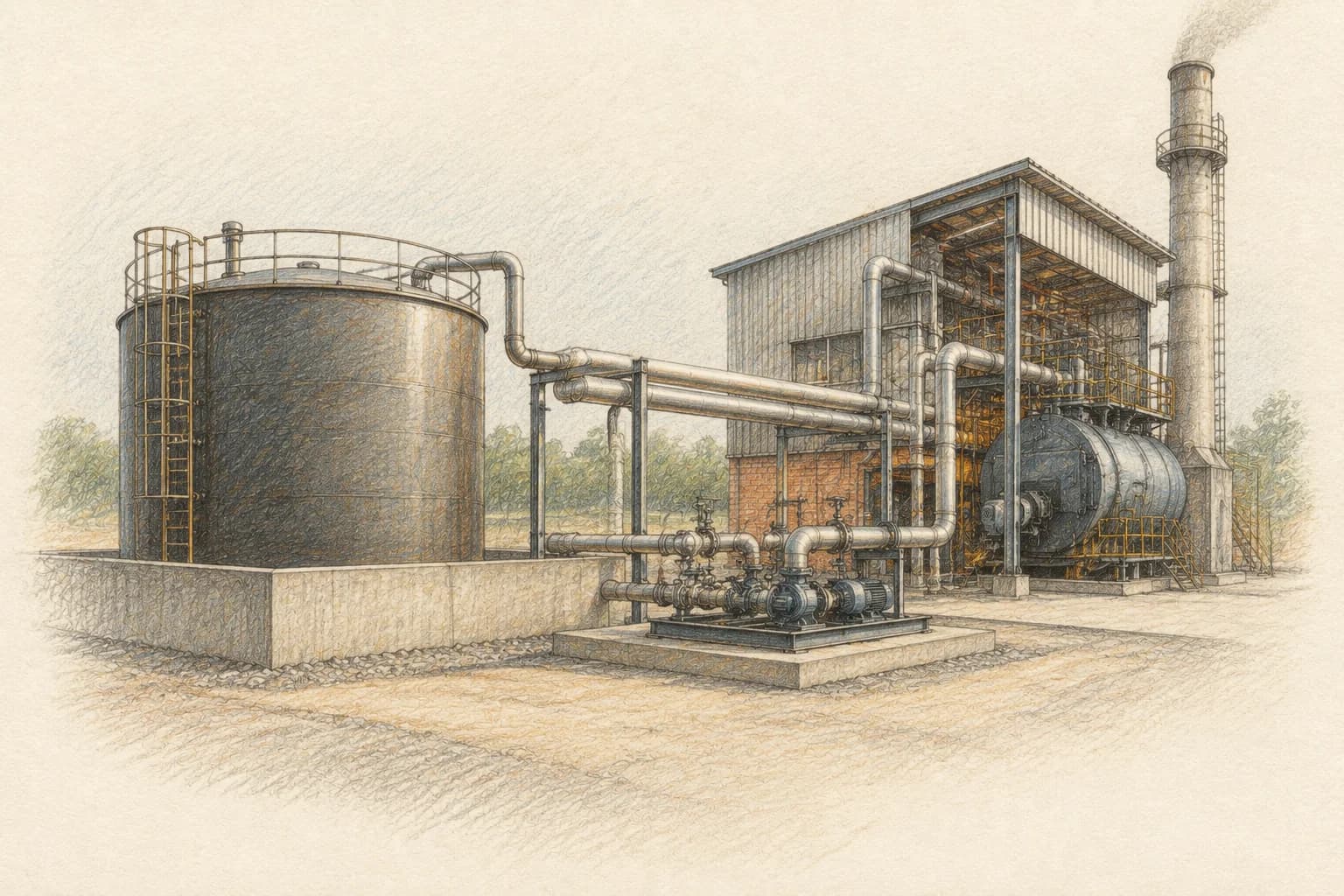
There are two basic approaches to keeping storage tanks workable. Bulk heating uses steam coils near the bottom of an insulated tank to warm the whole contents. Outflow heating warms only the oil as it leaves the tank, using a heat exchanger with steam or electricity as the heating medium. Outflow heating uses less energy, but bulk heating may be needed where flow rates are too high for a practical outflow heater, or when burning a fuel such as low sulphur heavy stock. Where bulk heating is used, insulating the tank substantially reduces steam use.
Thermostatic control is essential. Heaters should cut back when flow drops, and thermostats should sit where the oil flows freely into the suction pipe. An electric heater left on with no flow can carbonise the oil around the element.
Staying safe
- Do not heat fuel in storage more than needed for pumping. Higher temperatures raise vapour levels and energy use without benefit.
- Keep the temperature of the oil and the surrounding space well clear of the flash point. Marine guidance for low flash point deliveries is not to let the storage space come within 10°C of the measured flash point.
- Keep hot work and other heat sources away from fuel tanks and vents.
- Fit bund walls around above-ground tanks to contain spills, and refer to the product SDS for handling and fire-fighting advice.
Heat fuel oil only as much as each stage needs, and set every temperature from the actual fuel's data, not from habit.
Pumps and lines
Positive displacement pumps, such as gear pumps, are preferred for heavy fuel because they can move oil that is still cold and thick. Centrifugal pumps lose efficiency sharply as viscosity rises. Trace-heated and insulated lines prevent the oil cooling and thickening between the heater and the point of use. Coarse strainers on the tank inlet and finer strainers before pumps and burners protect the system from debris.
Information to request with a delivery
When ordering fuel oil or furnace oil, ask for the certificate of analysis to report viscosity, pour point, flash point and density so you can set heating temperatures before the oil arrives. Ask for the SDS as well. Nuroil supplies a certificate of analysis with every delivery and the MSDS on request, and can advise on packing and delivery options through the contact page.