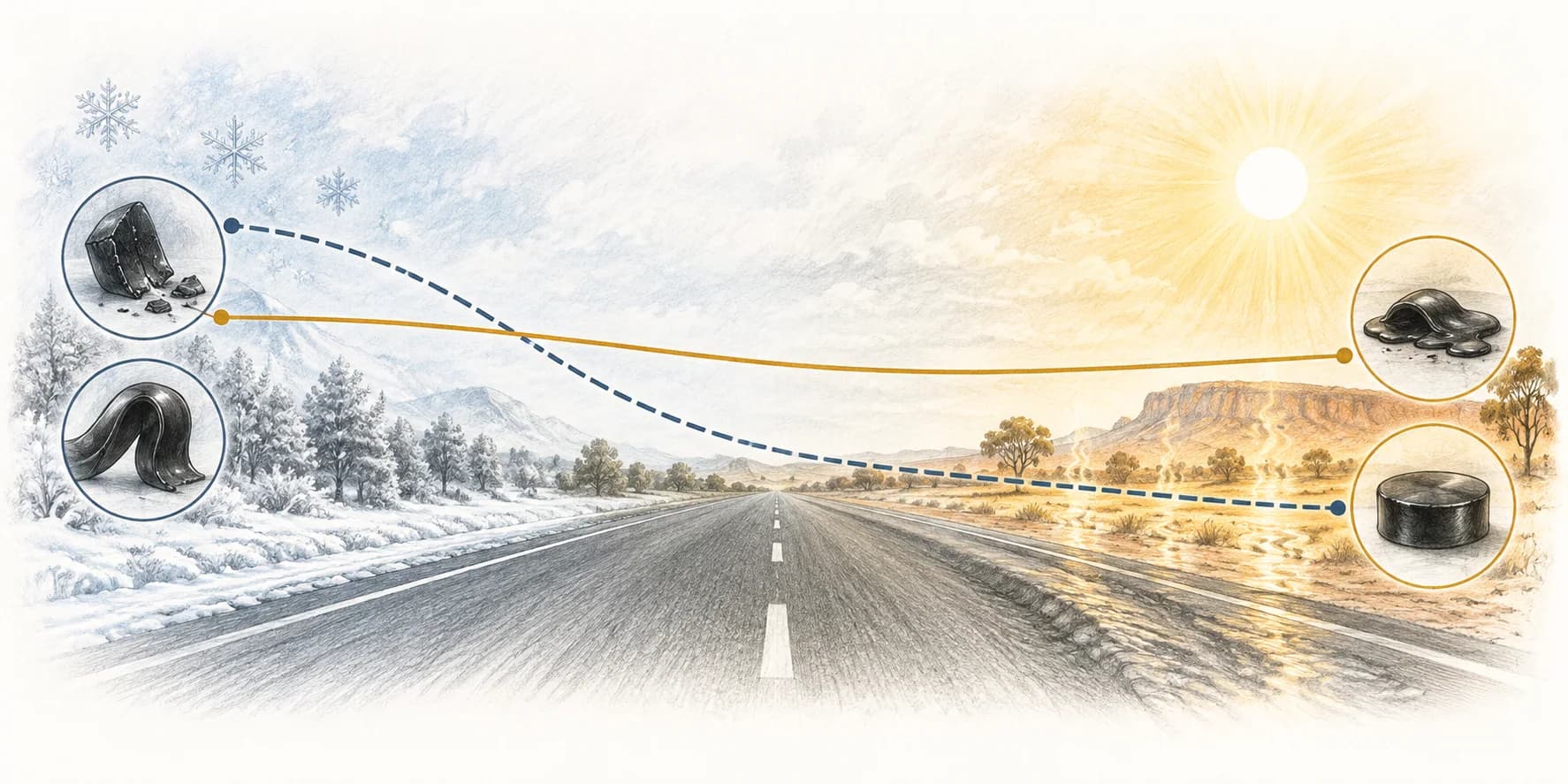
Bitumen quality can be lost after it leaves the refinery. Holding it too hot or too long hardens it through oxidation and loss of light fractions, which can push a compliant product out of its AS 2008 class before it reaches the road. This guide gathers the temperature ranges and holding times that producers publish for AS 2008 classes, so that storage and handling can be planned properly.
The basic rule
Store bitumen at the lowest temperature that still allows practical use, and raise it to working temperature only for the time needed. Every hour at high temperature adds some hardening. Industry guidance, including the Australian Asphalt Pavement Association advisory note on bitumen storage, is built on this principle.
Published temperature ranges
The table brings together recommendations from producer data sheets for AS 2008 classes. Ranges vary a little between suppliers, so follow the data sheet for the product you actually receive.
| Operation | Class 170, 240, 320 | Class 450, 600 | M500 | M1000 |
|---|---|---|---|---|
| Spraying | 175 to 185°C | Not normally sprayed | 175 to 185°C | Not normally sprayed |
| Asphalt mixing | 140 to 180°C | 140 to 180°C | Not normally mixed | 140 to 180°C |
| Asphalt compaction | 135 to 165°C | 135 to 165°C | Not applicable | 135 to 165°C |
| Storage up to 7 days | 140 to 180°C | 140 to 180°C | 140 to 180°C | 140 to 180°C |
| Storage up to 14 days | 130 to 150°C | 130 to 150°C | 120 to 140°C | 120 to 140°C |
Another producer gives a slightly different set for its conventional classes: up to 5 days at spraying temperature of 175 to 185°C, up to 10 days at mixing temperature of 140 to 170°C, and up to 30 days of medium-term storage at 120 to 140°C. For Class 320 specifically, one data sheet recommends mixing at 165 to 175°C, a holding time of 14 days at mixing temperature, medium-term storage at 130 to 150°C for 30 days, and a maximum safe handling temperature of 185°C.
Longer storage
Where bitumen must be held for more than a few weeks, drop the tank temperature further and reheat only when needed. Producers note that longer storage times are acceptable at lower temperatures, and suggest asking the supplier for advice on periods beyond their published limits. Reheating from cold should be gradual and the heating surfaces should not be allowed to overheat locally.
Signs that bitumen has been overheated
- Heavy blue fume above the tank or at the spray bar.
- A test result on the 60°C viscosity that has drifted upwards compared with the delivery certificate.
- Coke or hard deposits on heating coils or flues.
- Poor stone retention in seals or stiff, hard-to-compact asphalt.
Safety points
Hot bitumen causes serious burns and its fume should not be breathed. Keep water away from hot bitumen, since contact can cause violent foaming and boil-over. Keep tanks well below the flash point and never use an open flame to check levels. Use the product safety data sheet for protective equipment and first-aid guidance, and make sure staff know the maximum safe handling temperature for each class held on site.
Low and short is the rule: the cooler the storage and the shorter the time at working temperature, the closer the bitumen stays to its certificate.
Planning storage before you order
Match order size to the rate of use so that product does not sit hot for weeks. Tell the supplier how the bitumen will be received, whether in heated bulk tanks, drums or bags that must be melted, so the right packing is offered. Ask for the certificate of analysis to travel with the cargo, so on-site results can be compared with it. For AS 2008 classes in bulk or packed form, see the Australian Standard bitumen page or contact Nuroil.