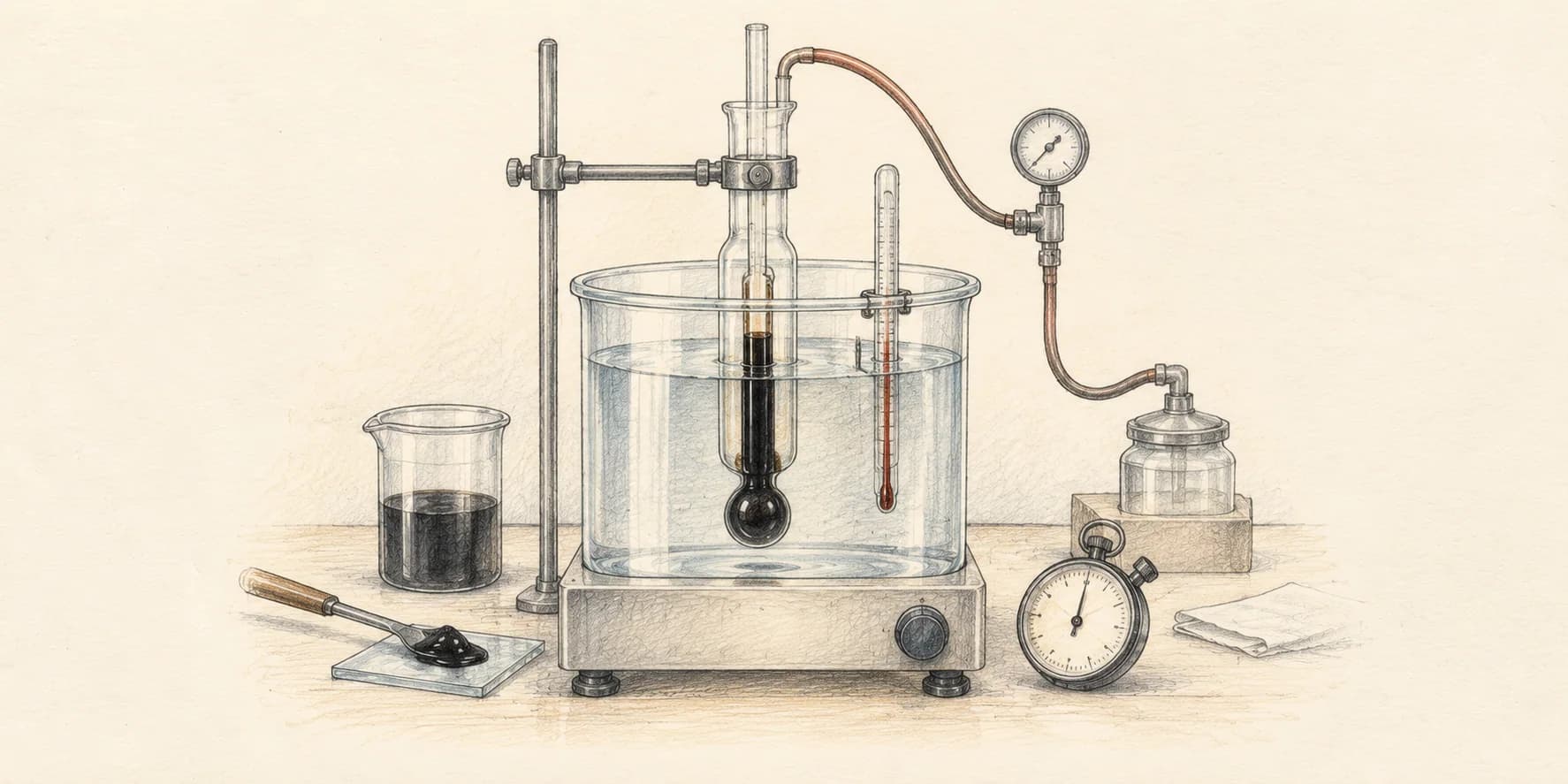
The single number that decides whether a lot is VG-10, VG-20, VG-30 or VG-40 is its absolute viscosity at 60°C. Because so much depends on it, buyers and site engineers benefit from knowing how the test works and where results can go astray.
Why 60°C
60°C was chosen because it approximates the highest surface temperature of an asphalt pavement in summer. Viscosity at that temperature relates to how well a binder resists flow and rutting on a hot road. A second test, kinematic viscosity at 135°C, covers the mixing range, and penetration at 25°C represents average service temperature.
How the test works
At 60°C bitumen is far too thick to flow through a narrow tube under gravity in a reasonable time. The absolute viscosity test therefore uses a vacuum capillary viscometer: a glass tube with a calibrated capillary section and timing marks. The binder is drawn up the capillary by a controlled vacuum while the viscometer sits in a constant-temperature bath at 60°C. The time taken to pass between marks, multiplied by the calibration factor for that section, gives viscosity in poise (or pascal seconds, where 1 Pa·s equals 10 poise).
The procedure is set out in ASTM D2171 and AASHTO T 202, and in IS 1206 Part 2 for IS 73 testing. ASTM D2171 covers a very wide range, from about 0.036 to over 200,000 poise, using several viscometer designs. Viscometers come in sizes for different ranges; for example, one common design's size 50 tube covers roughly 180–3200 poise and size 100 roughly 600–12,800 poise, so the laboratory picks a tube that suits the expected grade.
Sources of error
- Temperature control. Viscosity changes steeply with temperature, so even a small error in the bath shifts the result noticeably.
- Sample heating. Overheating the sample while pouring it hardens the binder and raises the result.
- Air bubbles and dirty tubes. Both disturb the flow.
- Wrong viscometer size. Flow times that are too short or too long fall outside the calibrated range.
- Modified binders. Polymer modified and recovered binders often behave in a non-Newtonian way under the test, so results may not be valid; the standard points to a different method for them.
What the result tells you, and what it does not
The 60°C viscosity places a binder within a grade band and indicates its rutting resistance compared with other conventional binders. It does not describe low-temperature behaviour, which is why penetration is retained, and it is measured at a single temperature. Comparing the 60°C and 135°C results gives a rough sense of temperature susceptibility.
| VG grade (IS 73) | Absolute viscosity at 60°C, poise | Same band in Pa·s |
|---|---|---|
| VG-10 | 800–1200 | 80–120 |
| VG-20 | 1600–2400 | 160–240 |
| VG-30 | 2400–3600 | 240–360 |
| VG-40 | 3200–4800 | 320–480 |
Laboratories usually report the average of duplicate determinations and check that they agree within the method's repeatability. When comparing a refinery certificate with an independent result, a small difference is expected; a large one points to a sampling, heating or temperature-control problem worth investigating. Because a lot is classified by where its result falls in a band, results close to a band boundary deserve a repeat test before any decision is made on grade.
The test after ageing
The same measurement is repeated on binder aged in the rolling thin film oven. IS 73 caps the ratio of aged to unaged viscosity at 4.0. A lot with a ratio well below the limit has hardened less in the simulated plant, which is a good sign for durability.
A VG grade is only as reliable as the 60°C test behind it. Ask who ran it and to which method.
When buying
Ask for the 60°C viscosity, the 135°C viscosity and the post-ageing viscosity ratio on the certificate, together with the test method references. For disputed results, both laboratories should use the same method, viscometer range and sample preparation. Nuroil provides a CoA with every viscosity grade bitumen delivery, and independent inspection can be arranged on request.