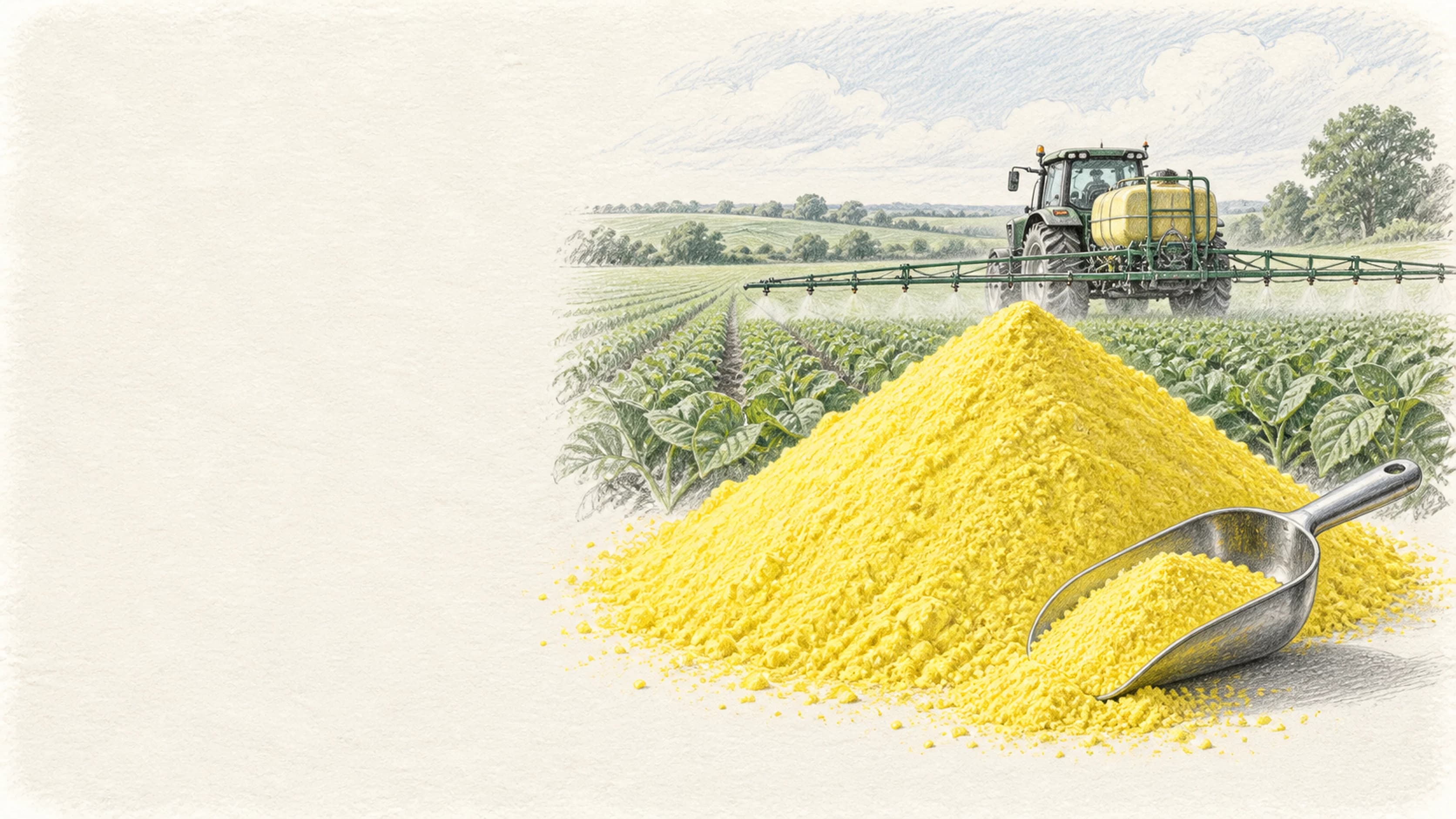
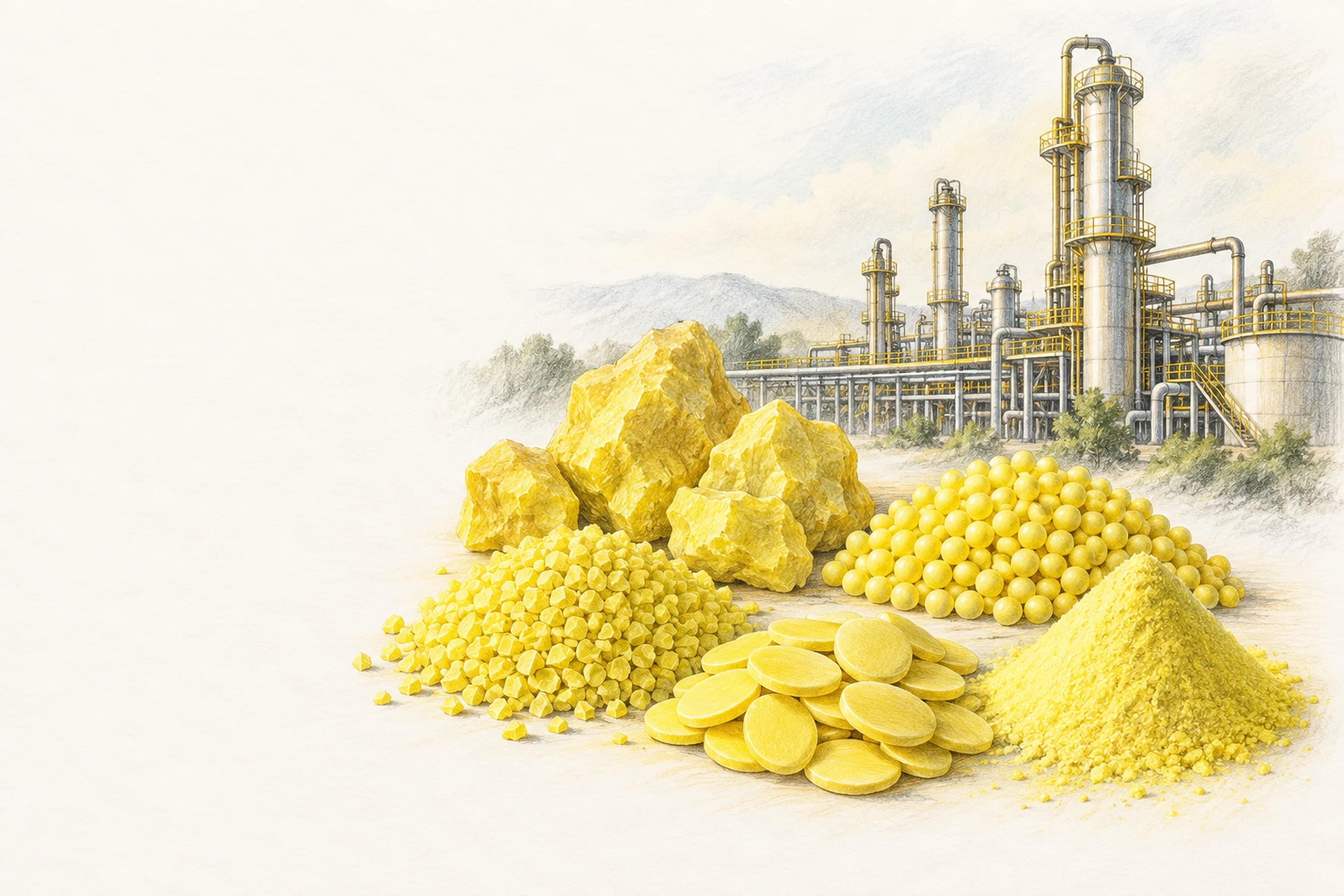
Sulphur is one of the oldest fungicides still in use. Ground and micronised sulphur is the raw material for dusting sulphur, wettable powders and water-dispersible granules that growers use against powdery mildew, rusts and some mites. For formulators and traders supplying this market, particle size is the specification that matters most.
How sulphur controls fungi
Sulphur is a protectant. It is applied to leaves and fruit before infection and forms a protective deposit that prevents fungal spores from germinating. It acts through contact and through vapour released from the particles, and it interferes with several processes inside the fungus at once. Because it works at multiple sites, resistance is considered unlikely, which is one reason sulphur remains in rotation programmes.
The flip side is that sulphur does not cure established infections. Labels and extension guidance stress application before symptoms appear, with repeat applications, often at intervals of 7 to 10 days, as new growth emerges while conditions favour disease.
Dusts, wettable powders and dispersible granules
- Dusting sulphur is finely ground sulphur applied dry with a duster. It is simple, but dust drift, uneven deposits and operator exposure make it harder to use well, and extension services often prefer spray formulations for that reason.
- Wettable powders combine very fine sulphur with wetting and dispersing agents so it can be mixed into water and sprayed.
- Water-dispersible granules are micro-granules that break down quickly in the spray tank. They reduce dust for the operator and are now common for professional use.
Agricultural sulphur feedstock is typically ground so that most of it passes a 325 US mesh sieve, which corresponds to roughly 44 microns. Formulators then mill further for wettable products, which commonly sit in the low single-digit micron range.
Why particle size matters
| Particle size | Effect |
|---|---|
| Very fine (below about 0.5 micron) | Highly volatile, very fast action, main cause of leaf burn |
| Fine (a few microns) | Good coverage and rapid action |
| Medium (tens of microns) | Slower vapour release, longer residual effect |
| Coarse (above about 100 microns) | Poor coverage, can block spray nozzles |
Good formulations aim for a balanced range: enough fine particles for rapid action and coverage, a share of larger particles for persistence, and minimal extreme fines that raise the risk of crop injury.
Because particle size distribution differs from one producer and one milling run to the next, formulators usually set an incoming specification for the raw sulphur and then check finished-product particle size separately. Consistent feedstock makes the downstream milling step easier to control.
Main cautions for users
- Heat. Sulphur can injure plants in hot weather. Extension guidance in warm regions advises against applying when air temperature is near or above about 32 degrees Celsius, and some crops and labels set lower limits.
- Oil sprays. Applying sulphur too soon before or after a horticultural oil spray can cause severe injury. Guidance commonly calls for at least two weeks between them, and some labels require longer.
- Sensitive crops. Some crops and varieties, including apricots and certain melons, are sensitive to sulphur. Always follow the registered label for the crop.
- Operator protection. Sulphur dust irritates eyes, skin and airways. Use the protective equipment shown on the label and SDS.
For fungicide use, sulphur must be sold and applied as a registered product under local pesticide rules. Bulk powder is a raw material for formulators, not a ready-to-use crop product.
Supplying formulators
Formulators buying sulphur powder as a raw material should specify purity, particle size distribution (for example the percentage passing 325 mesh, or a laser-diffraction profile), moisture, ash and acidity, and any flow agent that is or is not acceptable. Nuroil supplies sulphur powder with a CoA and can provide the SDS on request; share your specification through a quote request.