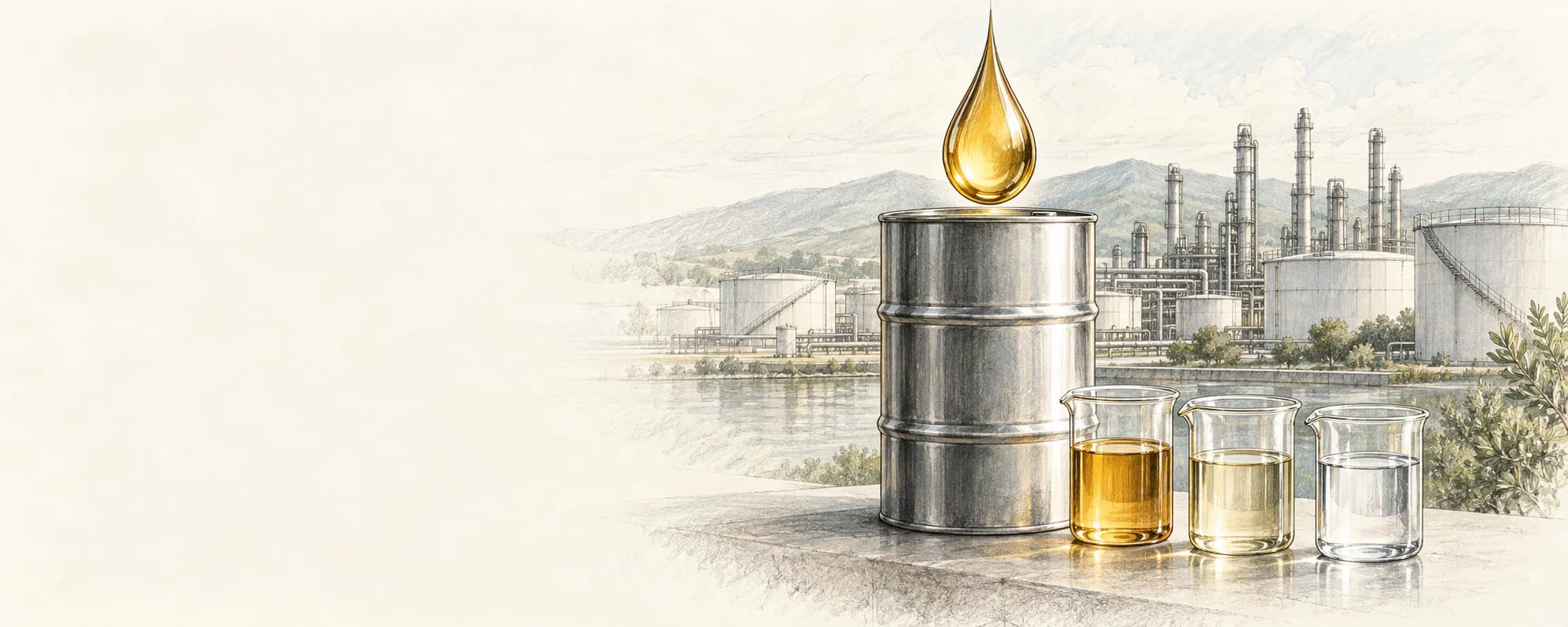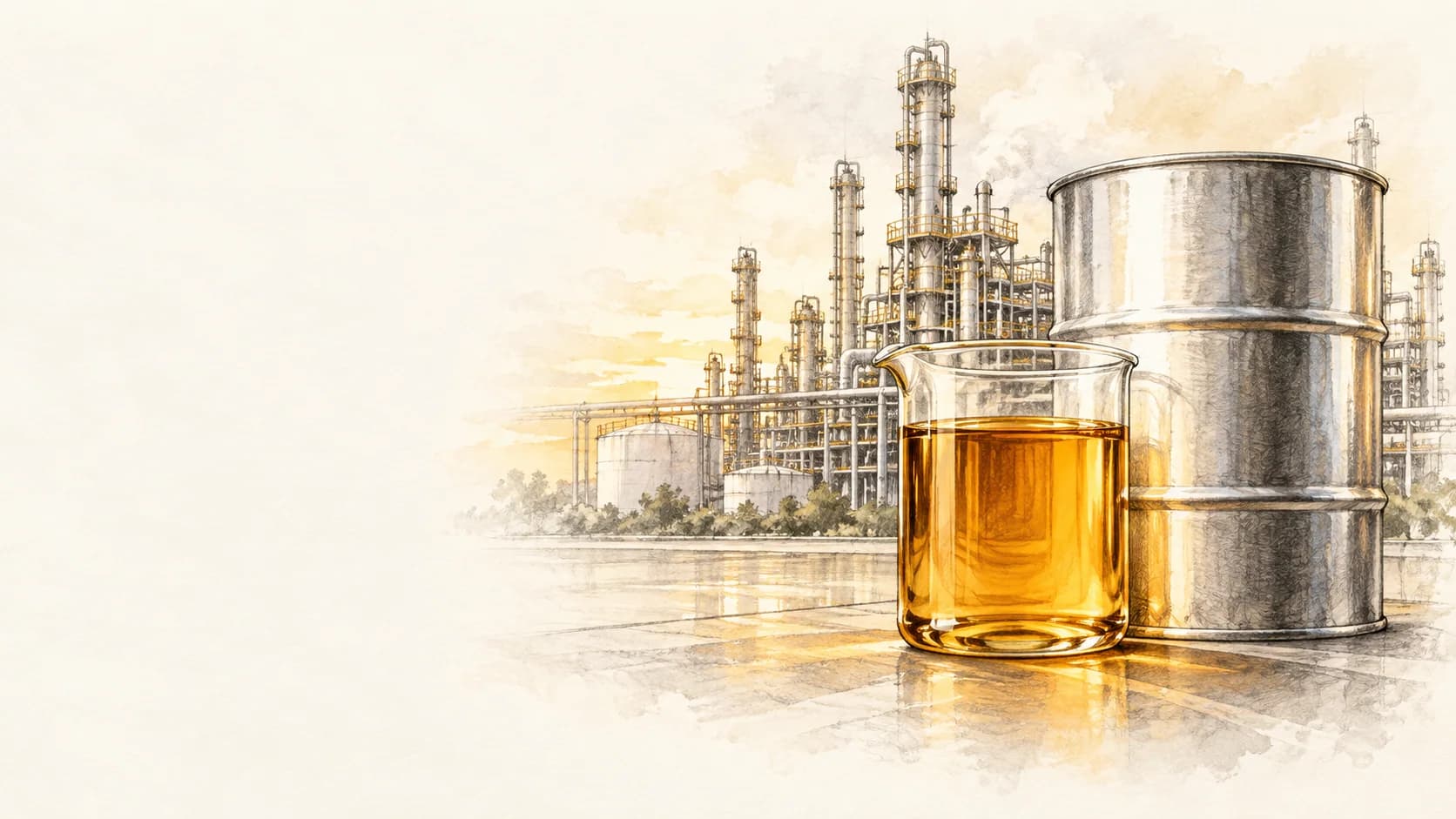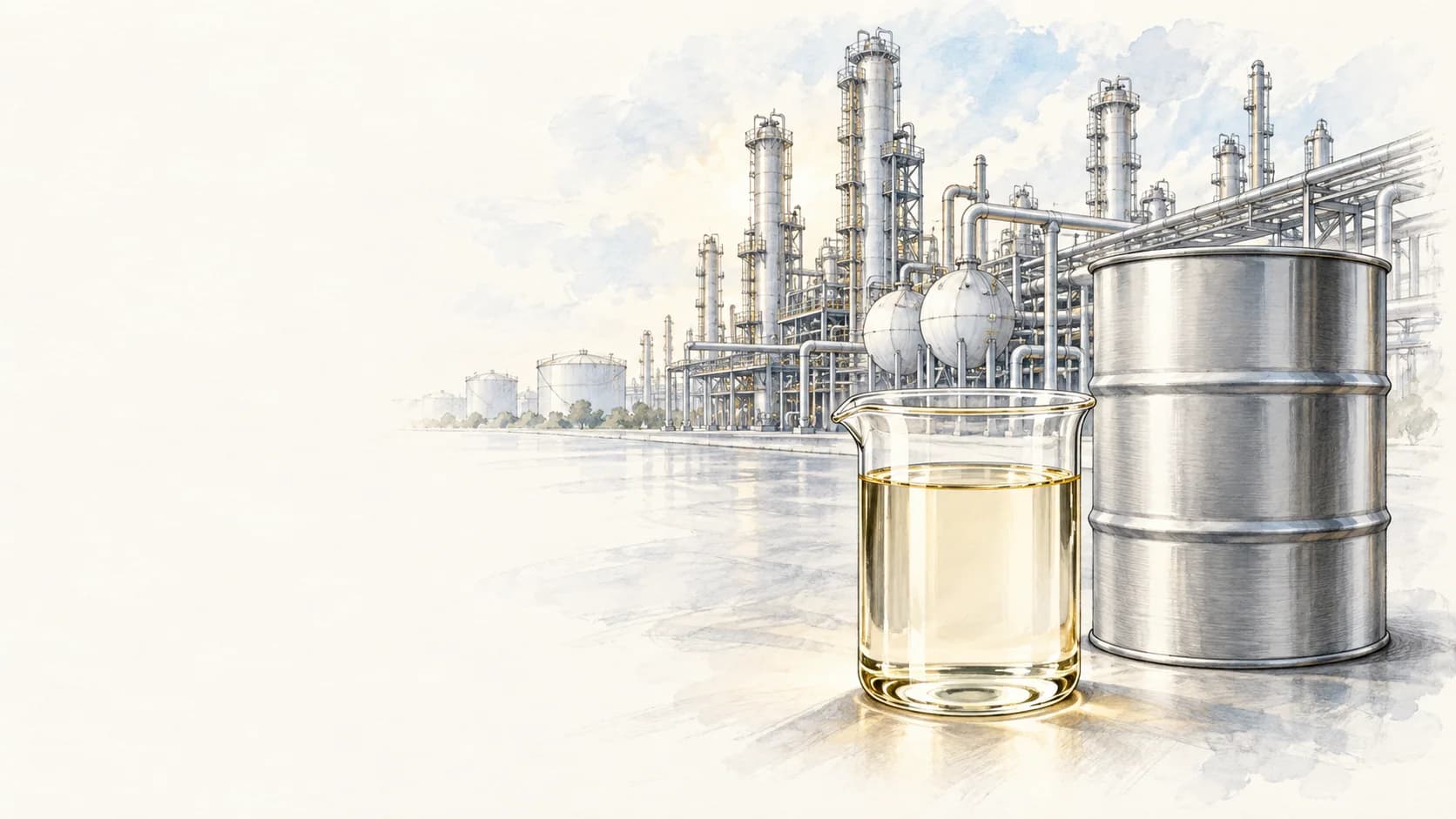
Group II base oil looks different from Group I the moment you see it: it is nearly water-white rather than pale amber. That difference comes from the way it is made. Instead of removing unwanted molecules with solvents, Group II refining uses hydrogen and catalysts to rebuild them. This article walks through the process and what it means for the oil a blender receives.
Feedstocks
Group II plants usually start from vacuum gas oil or deasphalted oil, the same broad lube-range fractions used for Group I. Some refineries also take unconverted oil from a fuels hydrocracker, which is already low in sulphur and aromatics. The feed is still split into light and heavy cuts, which become the N70 to N600 grades.
Step 1: hydrocracking or severe hydrotreating
The feed is reacted with hydrogen at high temperature and pressure over a catalyst. This removes most of the sulphur and nitrogen and saturates the bulk of the aromatic rings. Some ring molecules are also opened and some chains broken, which raises the viscosity index. Unlike solvent extraction, which separates out aromatics and loses them as extract, hydrocracking converts many of them into useful saturated molecules.
Step 2: catalytic dewaxing
The hydrocracked oil still contains waxy straight-chain paraffins. Rather than chilling and filtering them out, modern Group II plants use shape-selective catalysts, often zeolite or molecular sieve types, that rearrange those straight chains into branched ones. This is usually called hydroisomerisation or isodewaxing. Branched paraffins stay liquid at low temperature, so pour point falls while much of the wax is kept as base oil instead of being lost. Licensors report higher yield and quality than solvent dewaxing.
Step 3: hydrofinishing
A final, milder hydrogenation over a catalyst saturates the remaining aromatics, including traces of polynuclear aromatics, and removes colour bodies. The result is an oil with very high saturates, often well above the 90 per cent minimum, and very low sulphur.
| Step | Group I route | Group II route |
|---|---|---|
| Aromatics removal | Solvent extraction removes them | Hydrocracking converts them to saturates |
| Wax removal | Solvent dewaxing (chill and filter) | Catalytic dewaxing (isomerise wax) |
| Finishing | Mild hydrofinishing or clay | Hydrofinishing to saturate remaining aromatics |
| Typical result | Saturates below 90 per cent, sulphur above 0.03 per cent | Saturates at least 90 per cent, sulphur at most 0.03 per cent |
What the process gives the oil
- Colour. Hydrofinished Group II is typically 0.5 or lower on the ASTM colour scale.
- Low sulphur. Group II must have 0.03 per cent sulphur or less under the API definition, and in practice is often far lower.
- Better cold flow. Pour points of around -15 to -18 °C are common for the light and middle grades.
- Viscosity index. Generally 95 to 119, with the upper end marketed as Group II+.
- Lower solvency. With few aromatics or polar molecules left, the oil dissolves some additives less readily than Group I.
- Strong response to antioxidants. Saturated molecules oxidise slowly once properly inhibited.
Group I removes problem molecules; Group II rebuilds them with hydrogen. That is why Group II is clearer, lower in sulphur and more stable with additives, but less of a solvent.
Where the process limits Group II
Hydroprocessing makes very heavy grades harder to produce, so Group II slates usually stop around N500 or N600, with only a few heavier products. Blends that need bright stock-level viscosity often still combine Group II with Group I bright stock. Group II also remains below the viscosity index of 120 that defines Group III.
Buying implications
Because process severity differs between plants, Group II from different refineries can vary in viscosity index, volatility and solvency even when the grade names match. When you request Group II, specify measured viscosity, viscosity index, pour point, Noack volatility and saturates or sulphur, and ask for the certificate of analysis for the lot. Nuroil sources Group II from established producers with a CoA on every delivery; see the Group II base oil page or request a quote.