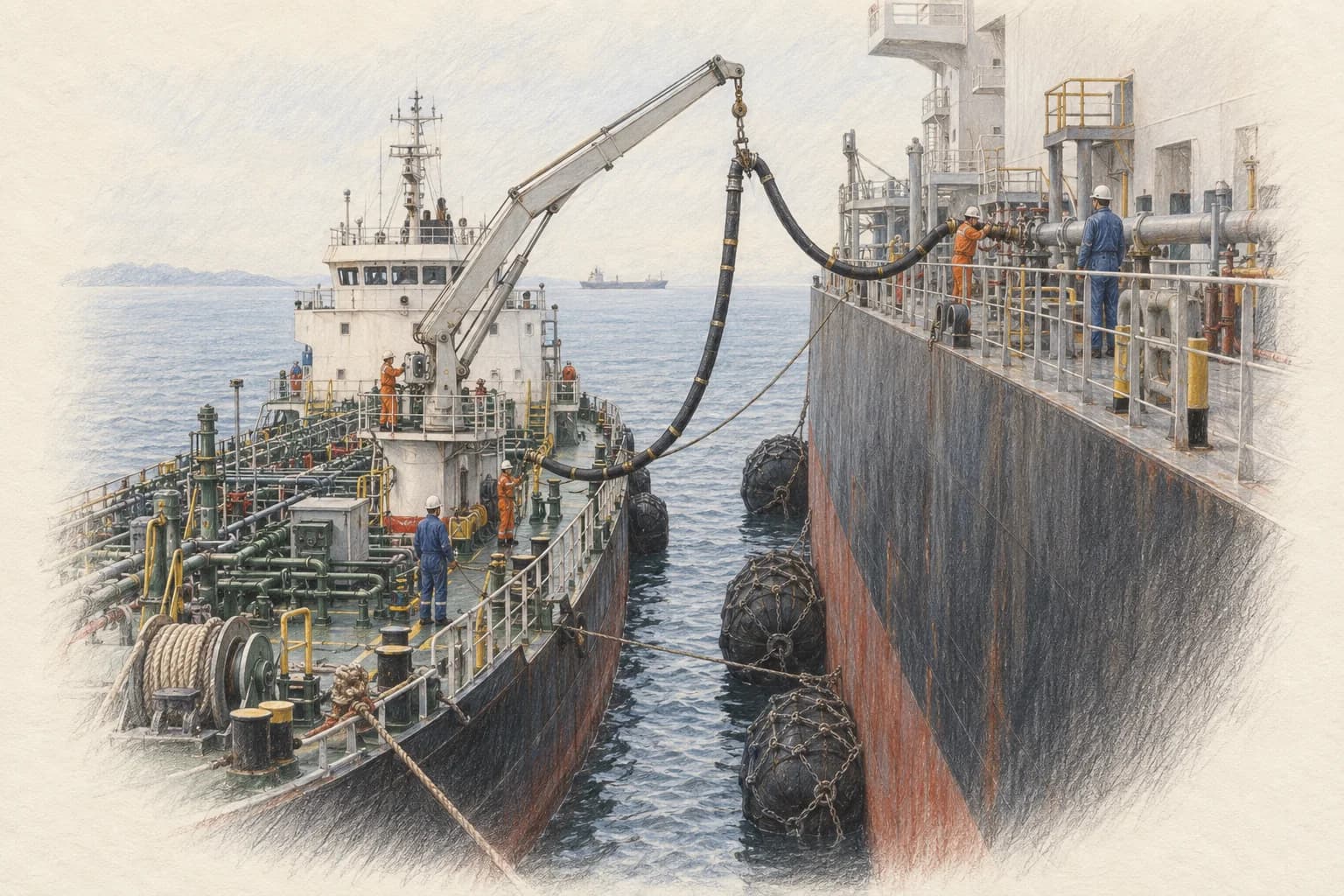
Since 2020, ships trading outside emission control areas have been limited to fuel with no more than 0.50% sulphur by mass. Yet high sulphur fuel oil (HSFO), usually around 3.5% sulphur, is still sold in major bunkering ports. The reason is the exhaust gas cleaning system, commonly called a scrubber. This article explains how scrubbers work and what changes for a ship that uses one.
The regulatory basis
MARPOL Annex VI, the international convention on air pollution from ships, sets the sulphur limit for fuel used on board: 0.50% globally and 0.10% inside designated emission control areas (ECAs). It also allows "equivalent" arrangements under Regulation 4, provided they achieve at least the same reduction in sulphur oxide (SOx) emissions as using compliant fuel. An approved scrubber is the most common equivalent.
A ship fitted with an approved and working scrubber may therefore burn HSFO and still be compliant. The approval is issued by the ship's flag administration and is recorded on the ship's International Air Pollution Prevention (IAPP) certificate. From March 2020, ships without such an arrangement may not even carry non-compliant fuel for their own use.
How a scrubber removes sulphur oxides
Exhaust from the engine or boiler passes through a tower where it is sprayed with water. Sulphur dioxide dissolves in the water and reacts with alkaline compounds in it, forming sulphites and sulphates that stay in the liquid. The cleaned gas leaves through the funnel. Performance is monitored continuously by measuring the ratio of SO2 to CO2 in the exhaust, which is linked to the fuel sulphur level it represents.
Open-loop, closed-loop and hybrid systems
| Type | How it works | Practical points |
|---|---|---|
| Open-loop | Uses seawater once, relying on its natural alkalinity, then discharges the wash water overboard after treatment | Simple, low running cost; less effective in low-alkalinity water; discharge is restricted in some ports and coastal waters |
| Closed-loop | Recirculates fresh water dosed with an alkali, usually caustic soda; a small bleed-off is treated and residues are stored for disposal ashore | Works anywhere; needs alkali supply, storage and sludge handling |
| Hybrid | Can switch between open-loop and closed-loop modes | Flexibility to use closed-loop where open-loop discharge is not permitted |
What changes for fuel management on board
- Compliant fuel is still needed. Where open-loop discharge is banned and the ship has no closed-loop mode, or when the scrubber is out of service, the ship must switch to compliant fuel. Most scrubber ships therefore carry some VLSFO or MGO as well as HSFO.
- Breakdown procedures. If the scrubber fails, the ship must follow the reporting and corrective procedures accepted by its flag, which usually means changing over to compliant fuel.
- Segregated tanks. HSFO and compliant fuels should be kept in separate tanks, both for compliance records and because mixing different residual fuels risks instability.
- Cylinder oil match. Two-stroke engines burning HSFO need a cylinder oil with higher base number to neutralise the acids formed from sulphur; this must be matched to the fuel in use.
Why scrubber ships still buy HSFO
For high-consumption vessels, the price gap between HSFO and compliant fuel can offset the cost of fitting and running a scrubber. HSFO is also a long-established product with predictable handling properties, while VLSFO quality varies more from batch to batch. Whether a scrubber pays off depends on fuel spreads, ship size, trading pattern and the waters where it operates.
A scrubber does not change what the rules require; it changes where the sulphur is removed, from the refinery to the ship's exhaust.
Buying HSFO for a scrubber-fitted vessel
When enquiring for HSFO bunkers, state the ISO 8217 grade (commonly RMG 380 or RMK 500), the edition of ISO 8217 to apply, quantity, port and delivery window. Confirm the bunker delivery note will show actual sulphur content, as HSFO deliveries must still be documented accurately. If the vessel also needs VLSFO or MGO for areas where the scrubber cannot be used, include those in the same nomination. Nuroil can be reached through the bunker and marine fuel page or request a quote.