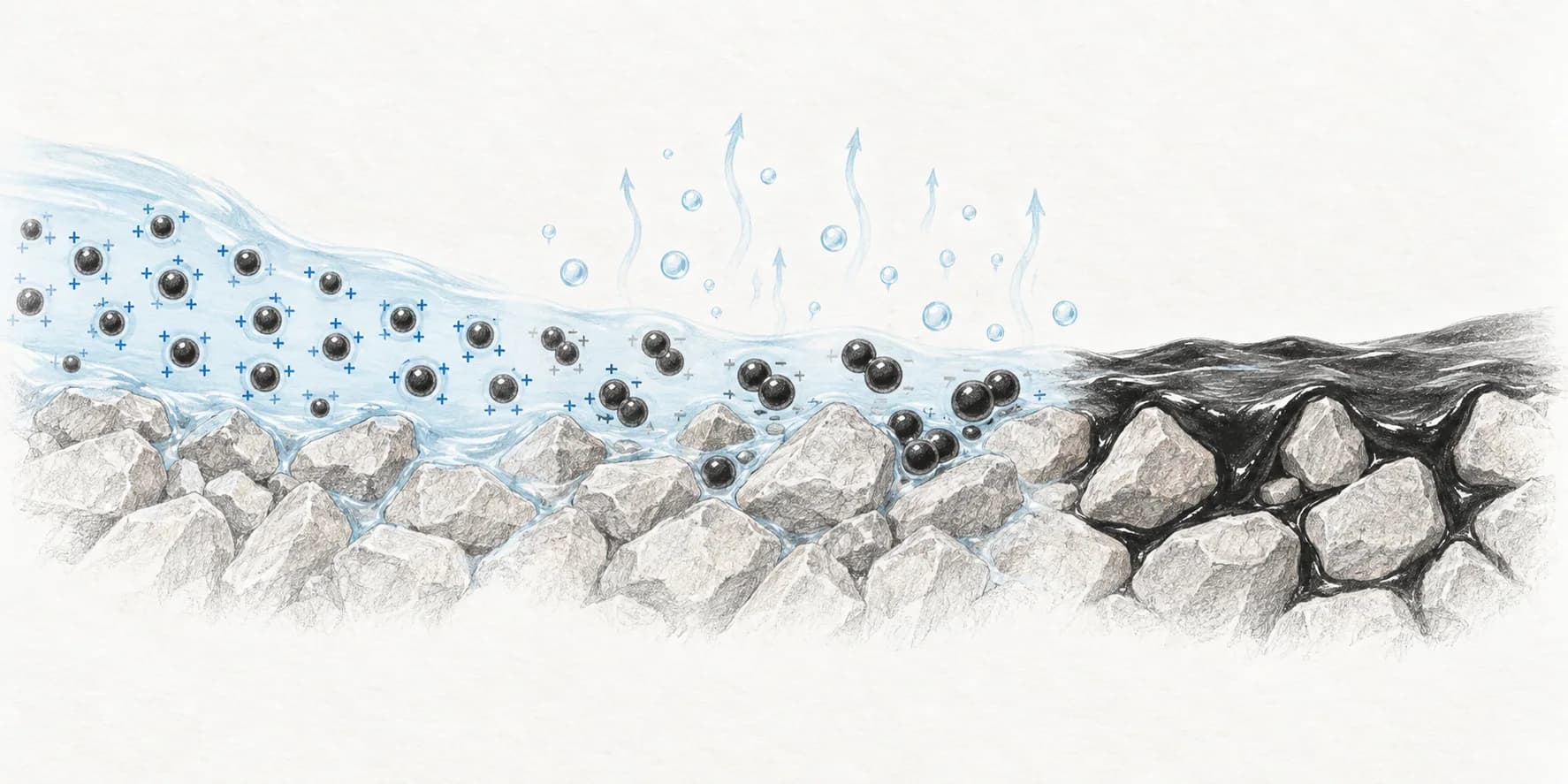
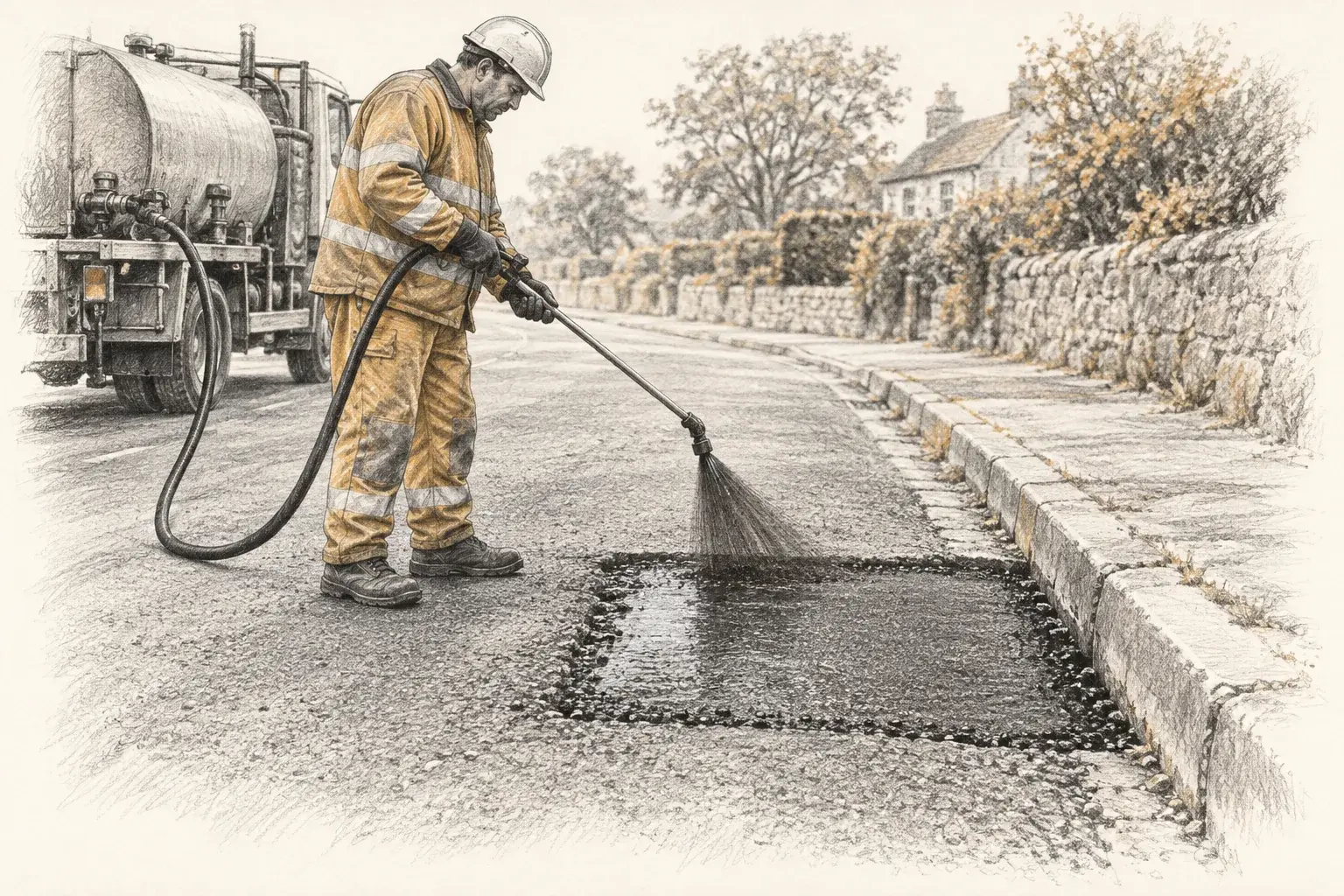
A bitumen emulsion is a dispersion of very small bitumen droplets in water, kept stable by an emulsifying agent. Because it is liquid at ambient or modestly warm temperatures, it can be sprayed or mixed without heating the bitumen to paving temperatures. Emulsions are classified in two ways: by the electrical charge on the droplets and by how quickly they break.
What is in an emulsion
- Bitumen, typically somewhere between about 40% and 70% of the emulsion by weight, depending on the grade.
- Water, which makes up most of the remainder.
- Emulsifier and additives, usually a small fraction of a percent to a few percent, which give the droplets their charge and control stability.
The emulsifier gives each droplet the same electrical charge, so they repel each other and do not merge in storage.
Cationic and anionic emulsions
Cationic emulsions carry a positive charge and are acidic. Anionic emulsions carry a negative charge and are alkaline. The charge matters because aggregate surfaces also carry a charge: siliceous stones such as granite and quartzite tend to be negative, while limestone tends to be positive. Coating and adhesion are generally best when the emulsion and aggregate carry opposite charges, which is why cationic emulsions are widely used with siliceous aggregates. Cationic grades are identified by a C at the start of the name.
Breaking and setting
Once applied, the emulsion breaks: the droplets come out of suspension and deposit on the surface, and the colour changes from brown to black. It then sets or cures as the water evaporates or drains away. Speed depends on the grade, the aggregate, the application rate, surface temperature, humidity and wind. In typical conditions setting takes around one to two hours.
Grades by setting speed
| Class | Example grade names | Behaviour | Typical uses |
|---|---|---|---|
| Rapid setting | RS-1, RS-2, CRS-1, CRS-2 | Breaks quickly on contact with stone | Chip seals, surface dressing, penetration macadam, some tack coats |
| Medium setting | MS-2, CMS-2 | Does not break immediately when mixed with coarse aggregate | Cold mixes, mixed-in-place and stockpile patching mixes |
| Slow setting | SS-1, SS-1h, CSS-1, CSS-1h | Most stable; suits mixing with fine, dense aggregate | Slurry seals, fog seals, tack coats, soil stabilisation, priming |
| Quick setting | QS-1h, CQS-1h | Engineered for fast traffic return in thin mixes | Slurry seal and micro surfacing systems |
In US-style designations, the number after the dash generally indicates viscosity (2 is more viscous than 1), and an h means the emulsion is made with a harder base bitumen. Other regions use different naming, so the same product may appear under a different label, and the governing standard should always be checked. In ASTM practice, anionic grades are covered by D977, cationic grades by D2397, and selection guidance by D3628.
Polymer modified emulsions, often marked with a P or a similar suffix, add elasticity and stone retention for demanding chip seals and micro surfacing.
Storage and handling
- Never let an emulsion freeze; freezing breaks it in the tank.
- Do not overheat it. Store within the temperature range on the data sheet and avoid local hot spots from heating coils.
- Do not mix cationic and anionic emulsions, or different grades, in the same tank; they can break and form solid bitumen.
- Keep agitation gentle. Excessive pumping or shear can cause premature breaking.
- Use stocks within the shelf life given by the supplier, and stir or circulate before use if they have stood for some time.
Pick the setting speed for the job, then pick the charge for the aggregate.
What to specify when buying
Give the grade and standard (for example CRS-1 to a named specification), the intended use and aggregate type, the quantity and packing, such as drums, IBCs or bulk tanks, and the expected storage period at destination. Ask for a certificate of analysis showing residue content, viscosity, sieve test, particle charge and storage stability. Nuroil supplies bitumen emulsions with CoA and MSDS, and can advise on packing for long sea transits.